
Vibe Coding for BPM: Business Processes Now Emerge in Dialogue
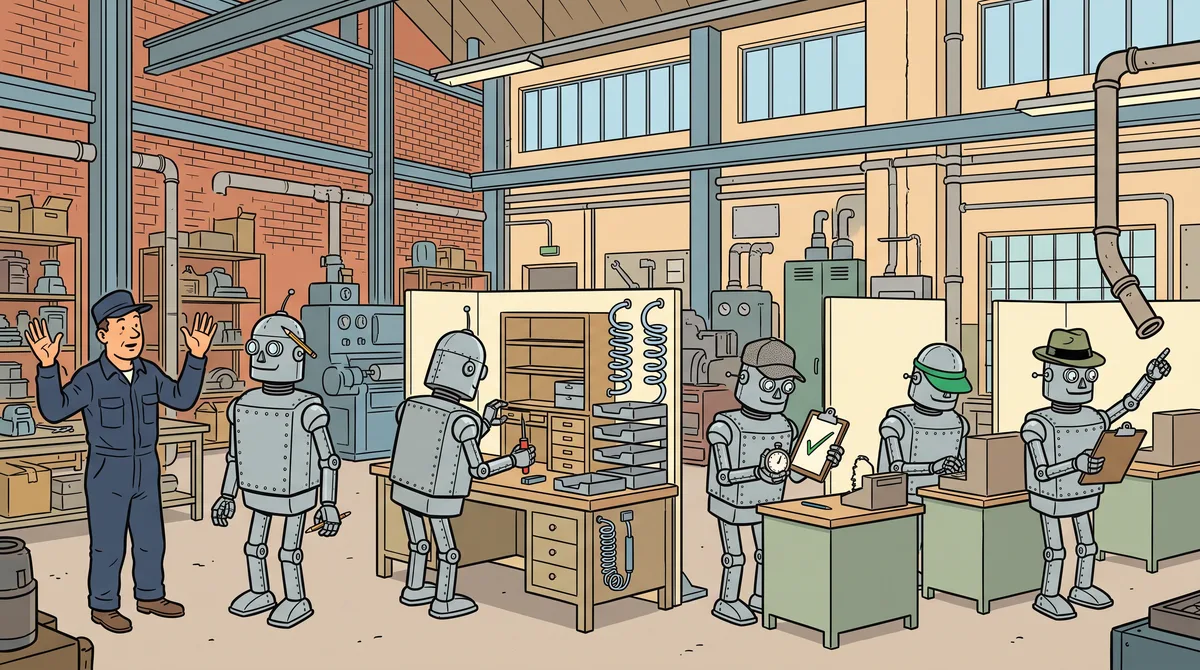
“Build me an application for equipment maintenance.”
Not long ago that would have been the start of a project. Today it can be a direct work instruction to an AI. This new way of describing software in dialogue and having it generated is often called vibe coding.
For business processes this is particularly interesting. After all, the business department usually knows the procedure it wants. It knows what an application needs to contain, who checks it, when an escalation becomes necessary and which exceptions occur. The laborious part used to come afterwards: translating this knowledge into a working application.
Vibe coding for BPM shortens exactly this path. But it takes a second step to make it more than fast generation: the AI tests what it has built.
A workflow is not yet an application
For equipment maintenance, a single workflow would not get you far. The application has to know which sites, devices and maintenance orders exist. Different people need different views and rights. If a repair exceeds its budget, an approval starts. Deadlines and notifications have to work.
That is why vibe coding for BPM at flying dog is not limited to a process graph. Using MCP, the AI generates the complete business application:
- Tables and relationships for the business data
- Interfaces and forms for the people involved
- Server-side functions and validation rules
- Roles, group inboxes and permissions
- The workflow including deadlines, escalations and notifications
These parts are created together. They do not have to be assembled into an application afterwards from different tools and work packages.
The difference begins after the build
A generated process can look convincing and still fail at a decisive point. Perhaps the case lands in the right inbox, but the approval button is missing. Perhaps a reminder is configured but is not sent when the deadline actually passes. Perhaps entries or open events disappear after a step back.
Such errors are no argument against AI-assisted development. They are an argument against untested AI-assisted development.
At flying dog, the AI therefore plays the built process through itself as every role involved. It logs in with test accounts, fills in forms, switches roles and reads the stored runtime state. In the test, deadlines really run out with shortened values. Every notification can be checked in the send log.
In one of our own tests, with an interstellar onboarding process, the result comprised 66 nodes and five groups involved. The AI ran through 15 test instances and found six errors in its own work. Among them was a warning and escalation mail that would never have been sent. The errors were fixed and tested again.
That is the decisive difference from one-off generation: the result is not the AI’s first answer but the application state that has been played through, with its test report.
Requirements become versions
With business processes, vibe coding does not end at the first go-live. Requirements keep changing. An approval limit is raised. An additional office has to be involved. A form needs a new field. After a reorganisation, a role no longer exists.
Even then the same way of working stays in place: the change is described, the AI rebuilds the application and then plays the whole process through again. The new test report belongs to the new version. Earlier states remain archived and can be compared.
This makes vibe coding more than a fast way to start. It becomes a lasting way of working for applications whose requirements keep evolving anyway.
People describe the work, AI builds the procedure
The business decisions stay with people. Who may decide, which control is necessary and which exception makes sense cannot be derived from a convincingly worded prompt. Whatever the AI cannot clearly take from documents has to remain visible and open to discussion as an assumption.
What changes is the path between these decisions and their implementation. Business departments can describe their process and experience the result from their own role. IT no longer has to translate every business change into data models, interfaces and test steps again.
Vibe coding for BPM is therefore more than a convenient new editor. It connects the language of the business departments directly with a complete application and a repeatable test cycle.
Challenge us with a process of your own.
The prompt is the beginning. The test report is the result.