
The New Wave of Digitalisation: AI Closes the Implementation Gap
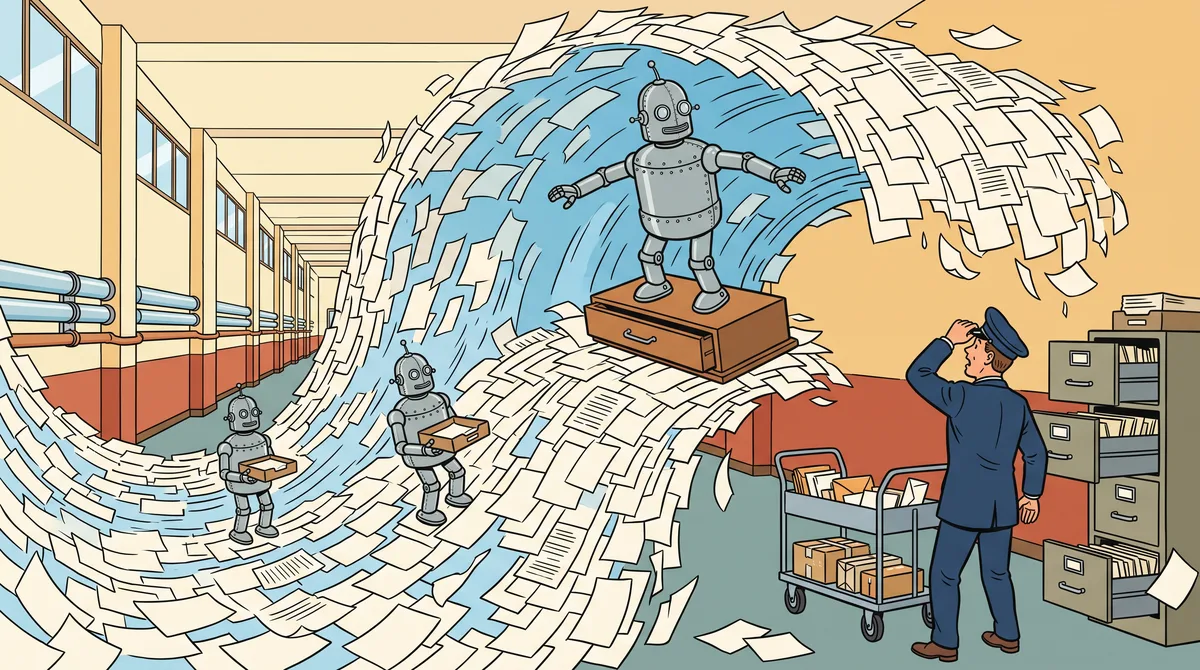
Every organisation has this list: the repair request, the visitor registration, the supplier approval, the form that still travels by internal mail. Everyone knows these procedures should be digitalised. Yet they stay where they are.
Not because their benefit is unclear. But because until now each of them could turn into a project.
The first wave of digitalisation moved documents, data and central business processes into software. The new wave changes something more fundamental: the cost and speed with which an organisation can translate its way of working into applications at all. In doing so, AI closes the implementation gap between the recognised need and the running process.
Digital documents were only the beginning
Many digitalisation projects removed paper from the procedure. The letter became an e-mail inbox, the form a PDF or a web form, the file a data record.
That was necessary progress. But a digitally transported form can still take the same manual route as its paper predecessor. Someone checks the details, gathers missing information, forwards the case and also records its status in a spreadsheet.
Large core systems have not fully closed this gap either. They map important standard processes, but not every local peculiarity, every handover and every later change. New digital detours therefore arise around the systems: Excel lists, e-mail distribution lists and personal notes.
What was digitalised was often the document. Not always the whole way of working.
The invisible majority of processes
The big procedures were implemented first, because budget, project team and rollout effort were easier to justify for them. Beneath them lies a large number of smaller and medium-sized procedures.
Individually they seem too minor for an IT project. Together they account for a considerable part of daily work. This is where applications are tracked, approvals obtained, exceptions coordinated and deadlines monitored by hand.
These processes were not left behind for lack of a digitalisation strategy. They were left behind because producing suitable software was the bottleneck.
On top of that come the already digitalised procedures whose software no longer fits the organisation. New responsibilities, different approval limits or an additional control step become known but do not get built in. The real process changes faster than its application.
The new wave begins with building the application
AI changes this bottleneck when it can do more than generate text about a process or draw a diagram.
At flying dog, requirements or existing documents become a complete business application. Using MCP, the AI builds the data model, forms, interface components, server-side logic and workflow together. Roles, group inboxes, deadlines, escalations and notifications are part of it.
The AI then plays the process through as every role involved. It uses test accounts, works with the real interfaces and reads the stored runtime state. In the test, deadlines really fire, and mail delivery can be verified in the send log. Errors that are found lead to correction and another test.
So a digitalisation idea does not first become another specification and development project. What emerges is a tested application state that those involved can experience for themselves from their own role.
Digitalisation becomes a permanent way of working
The most important change does not only concern the first version. Processes have to keep evolving, because organisations and their requirements do not stand still.
Until now, every change easily became another project: change request, effort estimate, development, test and approval. Many improvements were therefore collected, postponed or dropped altogether.
In the new way of working, the change is described. The AI rebuilds the application and then plays the whole process through again. The test report is filed with exactly the version that was tested. Earlier versions remain archived and can be compared or restored.
Digitalisation is thus no longer just the one-off transition from paper to software. It becomes the lasting ability to adapt work procedures to reality without a new implementation barrier.
The digitalisation backlog becomes a work list
For companies this changes the starting point. The existing list of undigitalised processes does not have to be described strategically all over again. It can become the immediate work list.
A sensible start is not necessarily the biggest process. Procedures where a lot of coordination happens today, where queries are frequent or where deadlines are monitored by hand are especially suitable. Existing descriptions, checklists, PDFs and screenshots can serve as source material. A completely new process can just as well be developed directly from requirements.
The business decisions stay with people. They determine responsibilities, controls and sensible exceptions. The AI takes over implementation and the repeatable test cycle.
So the new digitalisation wave does not become yet another programme that shows results only in a few years. It begins with one concrete procedure and one tested result.
The first wave of digitalisation replaced paper with software. The second replaces waiting with implementation.